Somatic Exercises You Can Do at Home From a Doctor of Chinese Medicine
A few years ago, I had a patient — a high-functioning attorney in her early forties — who came to see me for insomnia and what she described as "always being on." She exercised five days a week, ate well, had a meditation app she never opened. She was doing everything "right" and still felt like she was running on fumes.
When I asked her to pause for a moment and tell me what she felt in her body right in that moment, she stared at me. Not because she didn't want to answer — but because she genuinely didn't know how.
I see this more than almost anything else in my practice. And it's exactly what somatic exercises are designed to address.
For over 15 years, somatic movement has been part of my practice — through qigong, yin yoga, breathwork, and the body-awareness teachings embedded in Traditional Chinese Medicine. For me, these were never separate disciplines. They all work with the same basic premise: your body has an intelligence, and when you learn to work with it rather than override it, everything changes.
Below are ten somatic exercises drawn directly from my clinical practice and the movement traditions I teach. You can do all of them at home, with no equipment and no prior experience. I'd recommend starting with just two or three and building from there.
What Are Somatic Exercises — And Why Do They Work?
Somatic exercises are body-centered movement and awareness practices designed to work with your nervous system, not just your muscles. The word "somatic" comes from the Greek soma, meaning body, and somatic exercises invite you to pay attention to what you feel from the inside — sensations, qualities of movement, breath, and energy — rather than focusing on external outcomes like burning calories or building strength.
They work because the nervous system responds to sensation and safety. Chronic stress, anxiety, and unprocessed emotions aren't stored only in the mind — they live in the body as patterns of tension, restricted breathing, and dysregulated nervous system activation. Somatic exercises gently interrupt those patterns and help the body find its way back to equilibrium.
In Traditional Chinese Medicine, this is understood as moving qi — the life force that animates all body functions — through channels that can become stuck or blocked. When qi flows freely, health naturally follows. Many of these exercises are rooted directly in qigong, the ancient Chinese healing movement system, or in yin yoga and breathwork practices that work with the same meridian pathways.
For those dealing with anxiety in particular, somatic exercises for anxiety work because they shift the nervous system out of sympathetic (fight-or-flight) activation and into parasympathetic (rest-and-restore) mode — not through willpower, but through physiology.
Let's get into the practices.
1. Shaking and Tremoring (Qigong Style)
Shaking is one of the most primally effective somatic exercises I know, and the one I personally come back to most. In qigong, shaking the body is used to release stagnant qi, disperse tension, and reset the nervous system. Trauma researchers like Peter Levine have documented how animals naturally shake after a threatening event to discharge the stress response — we have the same capacity, and most of us never use it.
Stand with your feet hip-width apart and begin to gently bounce through your knees, allowing the vibration to travel up through your hips, spine, and arms. Let your jaw relax and your arms hang loose. Continue for 2–5 minutes, letting the movement be effortless and rhythmic. (It’s ok to smile and have fun 😃 ). When you stop, stand still and notice the tingling, warmth, or spaciousness in your body.
2. Body Scanning Meditation
Body scanning is the foundational somatic exercise — the practice of learning to feel your own body from the inside. Without this skill, all other somatic work is limited. I think of it as the literacy practice that makes everything else possible.
Lie down or sit comfortably and close your eyes. Beginning at the soles of your feet, slowly move your attention upward — feet, ankles, calves, knees, thighs, pelvis, belly, chest, hands, arms, shoulders, neck, face, and crown. At each area, simply notice whatever sensation is present: warmth, coolness, tightness, pulsing, or nothing at all. You're not trying to fix or change anything — just making contact with what is. Spend 10–15 minutes working through the full body.
3. Grounding Breath (Lower Dantian Breathing)
In Chinese Medicine, the lower dantian is the energy center located about three finger-widths below the navel. It's the seat of our vital essence — our deep reserves of qi — and also the physiological location of diaphragmatic breathing. When we breathe shallowly into our chests (which most stressed people do), we cut ourselves off from our center. This exercise reconnects us.
Place both hands on your lower belly, just below your navel. As you inhale through your nose, let your belly expand into your hands — not your chest. As you exhale through your mouth, let the belly soften inward. Make the exhale slightly longer than the inhale (try 4 counts in, 6 counts out). Practice for 5–10 minutes. This is one of the most effective somatic exercises for anxiety because it directly activates the vagus nerve and parasympathetic response.
4. Spinal Wave and Undulation
The spine is the highway of the central nervous system, and most of us keep it locked in rigid, habitual postures all day. Spinal undulation is a qigong and somatic movement practice that restores fluidity to the spine and, through it, to the entire nervous system.
Stand or sit upright and begin to let your spine move in a gentle wave — starting with a slight forward tuck of the pelvis, letting the movement ripple upward through your lower back, mid-back, and neck, then reverse the wave back down. Think of seaweed moving in water: continuous, unhurried, with no hard edges. Move slowly enough that you can feel each segment of your spine participating. Continue for 2–3 minutes, breathing naturally throughout.
5. Hip Circles and Pelvic Release
The hips and pelvis are where many people store unprocessed stress and emotion — this is well documented in somatic research and in the Chinese Medicine understanding of the liver and kidney meridians, which both run through the pelvis. Releasing this area has effects that ripple through the entire body and nervous system.
Stand with feet hip-width apart and knees slightly soft. Begin to make large, slow circles with your hips — as if you are slowly stirring something with your pelvis. Move in one direction for 8–10 circles, then reverse. Let your breath be full and unrestricted. If you notice any tightness or resistance in the circle, slow down there and breathe into it rather than moving through it quickly. This is one of the most cathartic somatic exercises for anxiety and stored emotional tension.
6. Heart Opening Chest Expansion
In Chinese Medicine, the heart houses the shen — our spirit and consciousness. The chest and pericardium region are associated with how we give and receive love, how open or guarded we are. Many of us spend our days hunched forward over screens, physically closing off the heart center. This exercise reverses that.
Stand or sit tall. As you inhale, gently draw your shoulder blades together and down, letting your chest open and lift. Let your chin rise slightly and your gaze soften upward. Hold this open position for 2–3 breaths, feeling the expansion through your sternum, collarbones, and front of your shoulders. As you exhale, return to neutral — not to a slumped position, but a relaxed upright one. Repeat 5–8 times. Notice what feelings or sensations arise when you open this area. This is body awareness in action.
7. Kidney Tapping (Chinese Medicine)
Kidney tapping is a qigong self-massage practice used in Chinese Medicine to tonify kidney qi — our foundational life force and the root of our vitality. The kidneys are associated with fear, will, and the depth of our reserves. Tapping the kidney area stimulates circulation, warms the lower back, and in TCM understanding, helps build the deep energy that stress and overwork deplete.
Make loose fists with both hands and bring them behind your back to rest on either side of your lumbar spine, just above your pelvis (over the kidney region). Begin to rhythmically tap — not hard, but firmly enough to feel it — alternating your fists in a gentle, steady rhythm. Continue for 1–2 minutes, breathing deeply. You may feel warmth spreading through your lower back. I often teach this as a morning practice to kindle energy for the day ahead.
---
8. Inner Smile Meditation (Mantak Chia Tradition)
The Inner Smile is a Taoist meditation practice brought to the West largely through the work of Mantak Chia. It's one of the gentlest and most surprisingly powerful somatic exercises I teach, and the one my patients are most skeptical of — until they try it.
Close your eyes and bring to mind something that genuinely makes you smile: a person you love, a place that brings you peace, a memory that warms you. Let that feeling of warmth settle into your face and eyes. Then, slowly, guide that smiling energy downward — into your throat, your heart, your lungs, your stomach, your liver, your kidneys, your intestines. Spend a few breaths at each organ, offering it the same warm, smiling attention. This practice builds the kind of body awareness and positive inner relationship that is the foundation of somatic healing. Practice for 10–15 minutes.
9. Yin Yoga Butterfly Pose with Breath Awareness
Yin yoga is a perfect somatic exercise practice because its long holds — 3–5 minutes per posture — give the nervous system time to move through initial resistance and settle into a deeper release. Butterfly pose targets the inner thighs, groin, and hip flexors — areas dense with the liver and kidney meridians — while the breath work makes it deeply somatic.
Sit on the floor and bring the soles of your feet together in front of you, letting your knees fall open. Allow your spine to gently round forward over your feet — not pushing or forcing, just letting gravity do the work. Close your eyes. With each inhale, notice where you feel the stretch. With each exhale, allow your body to settle a few millimeters deeper without effort. Stay for 3–5 minutes, using your breath as the primary tool. When you come up, pause for a full minute in stillness before moving. Notice what has shifted.
10. Closing Integration and Stillness Practice
Every somatic healing session needs a closing — a moment to let the nervous system integrate what it has just experienced. This is not optional. It's where the work actually lands in the body. I tell my students: the stillness at the end is half the practice.
After completing any combination of the above exercises, lie down in a comfortable position — on your back with your arms at your sides, or on your belly. Close your eyes. Set a timer for 5–10 minutes and simply do nothing. Let your breath be natural. Let your body be heavy. If thoughts arise, let them pass. Notice any sensations, warmth, pulsing, or shifts in energy without analyzing them. Just feel.
How to Build a Somatic Exercise Practice
You don't need to do all ten of these in a single session. A 20-minute practice using three or four exercises — ending always with the integration practice — will create real, felt change over time. Consistency is what matters.
I also want to name something honestly: somatic exercises can occasionally bring up emotional material that surprises you. If you find yourself feeling unexpectedly tearful, or noticing old feelings surfacing, that's normal and healthy. Your body is processing. You can slow down, return to grounding breath, and if you feel like you need support, that's a good time to reach out for guidance.
If you’re seeking more formal support, I offer acupuncture at a lovely Somatic Therapy office called Flourish in Cary, NC in addition to seeing patients in my private practice - Inner Body Data in Chapel Hill, NC (and Kaua’i in Winters!)
If you want a structured library of guided somatic practices — qigong classes, yin yoga, breathwork, and meditation — my Inner Body Data On Demand Membership is designed exactly for this. You can practice from anywhere, on your own schedule, with me guiding you through the same practices I use in my clinic.
I also post free qigong and yoga videos regularly on my YouTube channel — a good place to start if you want to get a feel for how I teach before committing to a membership.
Start Where You Are
You don't need to wait until you feel ready, or less stressed, or less busy. You can start right now, with whatever five minutes you have.
Your body has been waiting for your attention. It knows how to heal. These practices just help you meet it.
If you're ready to go deeper — whether that means one-on-one support through acupuncture and Chinese medicine, or a structured home practice — I'd love to work with you - Book a consultation, or explore the On Demand Membership (https://www.innerbodydata.com/membership) to find the right starting point.
---
Frequently Asked Questions About Somatic Exercises
How long does it take to see results from somatic exercises?
Most of my patients notice a shift in their nervous system state — a sense of greater calm, groundedness, or body awareness — within the first few sessions. Deeper changes, like reduced chronic anxiety or significant pain relief, typically emerge over weeks to months of consistent practice. In my experience, the people who see the most profound results are those who practice briefly and consistently rather than intensely and sporadically. Even ten minutes a day creates a cumulative effect that is genuinely transformative.
Are somatic exercises the same as somatic therapy?
They are related but different. Somatic therapy is a clinical intervention offered by a licensed therapist trained in approaches like Somatic Experiencing or Sensorimotor Psychotherapy. Somatic exercises are self-directed body-awareness practices — like the ones in this guide — that you can do at home as part of your wellness routine. Many of the practices overlap, and somatic exercises can support and complement therapeutic work. However, if you are working with significant trauma, I would recommend working with both a somatic therapist and a self-practice like the ones described here.
Which somatic exercises are best for anxiety?
For anxiety specifically, I recommend starting with lower dantian breathing (Exercise #3), shaking (Exercise #1), and the body scan (Exercise #2). These three work directly with the nervous system's stress response. The grounding breath activates the vagus nerve and parasympathetic state almost immediately. Shaking helps discharge the physical energy of anxiety — it's doing what your body wants to do anyway when it's in fight-or-flight. And the body scan helps you develop the interoceptive awareness to notice anxiety arising earlier, before it escalates. Practice these three daily for two weeks and see what you notice.
---
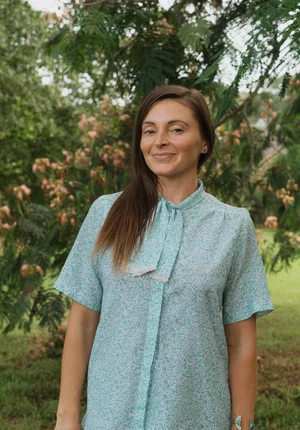
Dr. Sinead Corrigan is a Doctor of Acupuncture and Chinese Medicine, Licensed Acupuncturist, Board Certified Herbalist, and somatic movement teacher with 15+ years of teaching experience. She practices in Chapel Hill, NC and Kauai, HI, and offers an [On Demand Membership](https://www.innerbodydata.com/membership) for guided somatic practices you can access from anywhere.
Subscribe to her free [YouTube channel](https://www.youtube.com/@innerbodydatawithsinead) for qigong, yoga, and somatic movement videos, or [book a consultation](https://www.innerbodydata.com) to explore personalized support.